
Diagnostics
In Vitro Diagnostics Compliance and Registration
Regulatory market access for IVD instruments, reagents, and self-tests: classification, performance evidence, health authority registration, local holders, and the electrical and electronic approvals for analyzers.
The category
IVD regulation has tightened in most major markets, and the rest are following.
In vitro diagnostics, the reagents, kits, instruments, and software used to examine samples from the human body, were long regulated more lightly than therapeutic devices. That has changed. The EU IVD Regulation moved most IVDs into classes requiring notified body involvement. National authorities across Asia and Latin America have expanded IVD-specific rules, tightened performance evidence requirements, and extended registration to product types previously exempt. Self-tests and point-of-care devices face particular scrutiny.
The IVD file has its own logic. Classification is by the intended use and the risk of an incorrect result, and it differs between jurisdictions. Performance evidence, analytical and clinical, is central and often has to reflect the target population. Stability, traceability of calibrators and controls, and software validation carry weight. Instruments add the medical electrical file: IEC 61010-2-101 for IVD equipment safety, EMC, and often laboratory-environment requirements, plus radio approval for connected analyzers and point-of-care devices.
ORBIS Compliance works with IVD manufacturers on registration with health authorities, local holder representation, and the electrical and radio approvals for instruments, so the reagent file and the instrument file reach each market together.
Product types
Diagnostic products we support
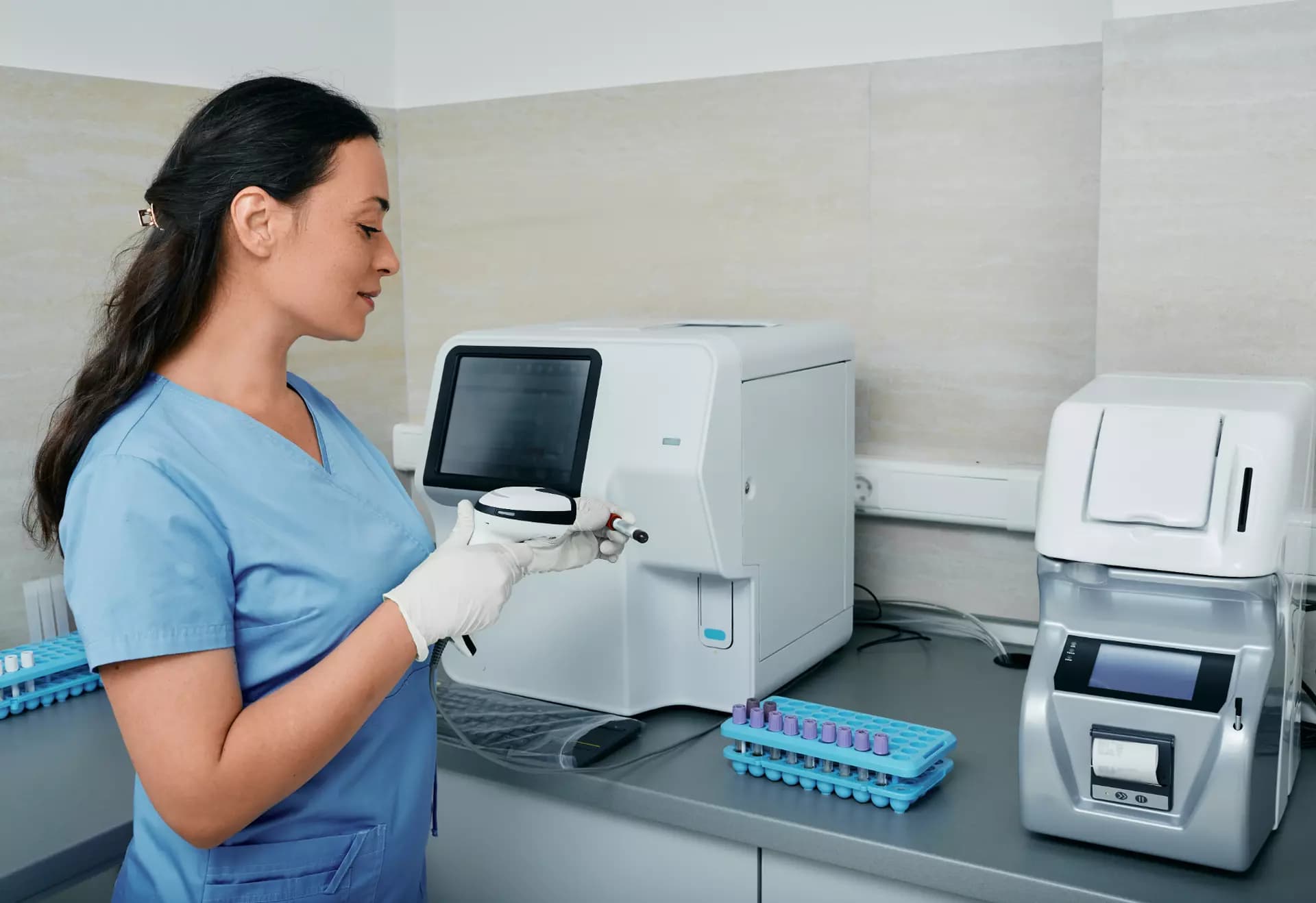
Laboratory analyzers
Clinical chemistry, immunoassay, hematology, molecular, and microbiology instruments under IVD registration and IEC 61010-2-101 electrical safety.
Reagents and kits
Assays, calibrators, controls, and consumables registered by intended use and class, with performance and stability data to each authority's expectations.
Point-of-care devices
Handheld and near-patient analyzers, often battery-powered and connected, combining IVD registration with radio, battery, and electrical approvals.
Self-tests
Consumer-use diagnostics under the strictest IVD classes in most markets, with usability, labeling, and lay-user evidence requirements.
IVD software
Standalone diagnostic software and algorithms regulated as IVDs in their own right, with classification and validation requirements.
Sample collection and handling
Collection kits, transport media, and pre-analytical devices, whose regulatory status varies between markets.
Instruments are also electronics
The analyzer needs the electrical file the reagent doesn't.
IVD instruments are laboratory electrical equipment. Beyond IVD registration they need electrical safety evidence under IEC 61010-1 and IEC 61010-2-101, EMC to IEC 61326 or the medical EMC standard depending on market and intended environment, and in many countries a separate national electrical certification. Connected analyzers and point-of-care devices add radio type approval for every transmitter. Battery-powered devices add battery certification and producer obligations.
These approvals come from different authorities than the IVD registration, on different timelines, sometimes with different local holder requirements. In a program managed only through the health authority lens, they're the ones that get missed.
ORBIS scopes the instrument safety and EMC and radio evidence alongside the IVD dossier, and manages the national electrical certifications and local representation each market requires, so the instrument clears customs when the reagent does.
How ORBIS manages IVD market access
From classification to a registered product with a valid instrument
- 1
Classify and plan
IVD classification and registration route confirmed per market, alongside the instrument's electrical, EMC, and radio requirements.
- 2
Build both files
The IVD dossier and the instrument certification program are assembled so they describe the same product and reach each authority on a coordinated schedule.
- 3
Register and certify
Applications are filed under the local holder, instrument certifications are obtained, and authority questions are answered by people who know the product.
- 4
Maintain
Reagent changes, instrument software updates, and regulatory changes are assessed against every registration and certificate in ORBIS Intelligent Compliance.
Questions
IVD compliance
Our IVD is CE marked under the IVD Regulation. Does that help elsewhere?
+
Often, yes. Many markets offer reliance or abbreviated routes for IVDs with CE marking under the IVDR, FDA clearance, or other reference approvals. The national registration and local holder are still required, and some authorities want local performance data. ORBIS maps the reliance routes for your product per market.
Do reagents and instruments register separately?
+
In most markets, yes, though they're often linked as a system. Each has its own classification, dossier, and validity. Instruments additionally need electrical and, where connected, radio approvals from other regulators. Coordinating the timelines is part of what ORBIS does.
How are self-tests treated differently?
+
They're generally in the highest IVD classes, with additional requirements for usability studies with lay users, labeling and instructions for non-professionals, and sometimes restrictions on sale channels. Several markets have specific self-test rules. We confirm the requirements per market before you plan a consumer launch.
Get diagnostics registered where the samples are.
Bring the assay or instrument, its classification and performance data, and the markets. We'll map the IVD registration route and the instrument approvals for each, and the holder they'll need.
Book a Discussion